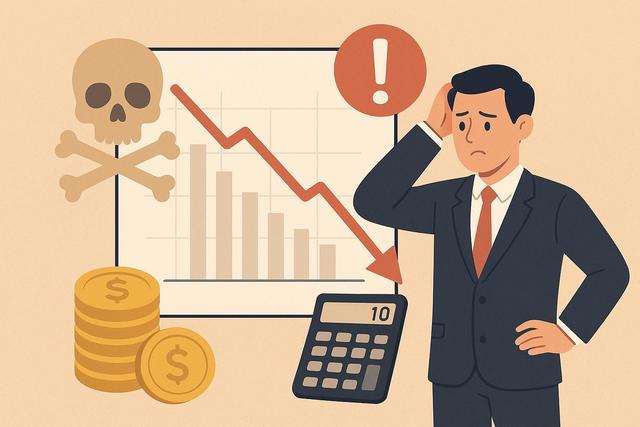
In the complex world of business, certain financial indicators can act as early warning signals for potential failure. Identifying these numbers enables businesses to react proactively, potentially saving themselves from a downward spiral. This article explores ten critical figures that can predict business failure, complete with real-world examples, actionable insights, and authoritative references.
Revenue Decline
Explanation
A consistent decline in revenue is an immediate red flag for businesses. This metric measures the total income generated by the sale of goods or services. A downward trend over multiple quarters can indicate underlying issues in product demand, pricing strategies, or market conditions.
Real-World Examples
For instance, Kodak's revenue decline in the early 2000s heralded its eventual downfall, as the company failed to adapt to digital photography. Their consistent quarterly losses signaled a lack of innovation and market responsiveness.
Data Points
According to a Deloitte study, 60% of companies experiencing a year-over-year revenue decline enter bankruptcy within two years.
Strategic Insights
Businesses should regularly assess their revenue streams and compare them against industry benchmarks. It's crucial to diversify income sources to mitigate risk.
Critical Perspective
Not all revenue declines are disastrous if addressed with a strategic overhaul in business operations or market outreach.
Decreasing Profit Margins
Explanation
Profit margins measure how much profit a company keeps relative to revenue. Shrinking margins can indicate rising costs or diminishing pricing power.
Real-World Examples
Sears experienced shrinking profit margins for years before declaring bankruptcy. Rising overheads and an inability to compete with online retailers eroded its profitability.
Data Points
Research from PwC indicates that a consistent reduction in profit margins over three quarters often leads to dire financial performance.
Strategic Insights
Regular cost audits and competitive pricing strategies are essential. Automating processes to reduce labor costs can also safeguard margins.
Critical Perspective
While margins are critical, they should be evaluated alongside industry trends to avoid overreaction.
High Debt-to-Equity Ratio
Explanation
This ratio compares a company's total liabilities to its shareholder equity. A high ratio suggests over-leveraging, which can lead to financial distress.
Real-World Examples
Toys 'R' Us had an unsustainable debt-to-equity ratio, which heavily contributed to its bankruptcy in 2017 following a leveraged buyout.
Data Points
A ratio above 2 is often a red flag, according to Investopedia, indicating that a company might struggle to meet its debt obligations.
Strategic Insights
Organizations should prioritize debt reduction strategies and explore equity financing to achieve a balanced financial structure.
Critical Perspective
High ratios are sometimes industry-specific and could represent strategic growth rather than distress.
Declining Cash Flow
Explanation
Cash flow is king in business. Negative cash flow implies that a company is spending more cash than it generates, unsustainable in the long run.
Real-World Examples
Blockbuster's decline was partly attributed to declining free cash flow, which crippled its ability to invest in necessary business model changes.
Data Points
From an EY report, companies with declining cash flow over three successive years face a 20% higher risk of bankruptcy.
Strategic Insights
Effective cash flow management involves forecasting future cash conditions and adjusting expenses accordingly.
Critical Perspective
One-time expenditures causing temporary dips shouldn't be overemphasized as cash flow issues.
Inventory Turnover Rate
Explanation
This ratio measures how often inventory is sold and replaced over a period. Lower rates indicate inefficient stock management.
Real-World Examples
J.C. Penney's failure was preceded by an inventory turnover rate that lagged behind competitors, signifying poor stock management.
Data Points
According to McKinsey, a turnover rate significantly below industry average often predicts upcoming financial troubles.
Strategic Insights
Optimizing supply chain processes and adopting demand forecasting technology can help maintain healthy turnover rates.
Critical Perspective
Seasonal businesses may naturally experience fluctuations in inventory turnover without implying distress.
Current Ratio
Explanation
This liquidity ratio compares current assets to current liabilities, highlighting a company’s ability to meet short-term obligations.
Real-World Examples
RadioShack, with a perilously low current ratio before its collapse, was unable to cover its short-term debts, leading to insolvency.
Data Points
A current ratio below 1 suggests significant liquidity issues, according to CFA Institute guidelines.
Strategic Insights
Regular liquidity assessments and maintaining a buffer of current assets can prevent liquidity crunch situations.
Critical Perspective
The current ratio should be interpreted within the context of industry norms to prevent misjudgment.
Interest Coverage Ratio
Explanation
This ratio measures how easily a company can pay interest expenses on outstanding debt. Lower ratios indicate financial vulnerability.
Real-World Examples
Lehman Brothers had a deteriorating interest coverage ratio leading up to its 2008 collapse, indicative of its overextended financial commitments.
Data Points
A ratio below 1.5 is a clear warning signal, suggesting potential struggles to cover interest expenses, based on S&P Global data.
Strategic Insights
Reducing reliance on debt through strategic partnerships or equity financing can enhance this ratio.
Critical Perspective
While concerning, temporary dips may reflect aggressive growth strategies that pay off long-term.
Accounts Receivable Turnover
Explanation
This ratio indicates the effectiveness of a company’s credit policies and collection processes. Lower rates suggest inefficiencies and cash flow problems.
Real-World Examples
Toys 'R' Us also struggled with an accounts receivable turnover lagging behind industry norms, reflecting poor cash conversion cycles.
Data Points
According to a Harvard Business Review study, businesses with declining receivable turnover face a 25% increase in credit risks.
Strategic Insights
Implementing stricter credit terms and improving collection strategies can stabilize receivable turnover rates.
Critical Perspective
A single customer delaying payment can temporarily distort this ratio, warranting cautious interpretation.
Gross Profit Margin
Explanation
This margin reveals how efficiently a company produces its goods, with declining rates indicating cost management issues.
Real-World Examples
Barnes & Noble's slumping gross margin mirrored its operational inefficiencies, amid competition from digital platforms.
Data Points
According to BCG, a gross margin consistent decline over multiple quarters suggests deeper operational problems.
Strategic Insights
Analyzing cost structures and investing in technology can significantly uplift gross profit margins.
Critical Perspective
Contextual factors such as market expansion or product investment could affect margins short-term without implying failure.
Net Profit Margin
Explanation
Net profit margin considers total sales minus total expenses, highlighting overall profitability. A declining trend can expose fundamental business weaknesses.
Real-World Examples
Borders Group's plummeting net profit margins showcased its struggle against market dynamics and high operational costs.
Data Points
Research from Bain & Company indicates a persistent decline in net margins corroborates impending business distress within 18 months.
Strategic Insights
Streamlining operations and managing expenses through strategic partnerships can bolster net profit margins.
Critical Perspective
Margin evaluations should consider broader economic conditions to avoid misrepresented assessments.
Conclusion
Understanding these ten critical financial indicators provides businesses with a strategic edge in identifying potential failure early. Companies can implement the following actionable steps: 1) Regularly monitor key financial ratios and adjust strategies accordingly. 2) Use industry benchmarks to understand broader trends and adapt. 3) Prioritize financial audits and maintain liquidity to buffer against unexpected economic shifts. By staying vigilant and adaptable, businesses can not only avert potential crises but thrive in a competitive market.

