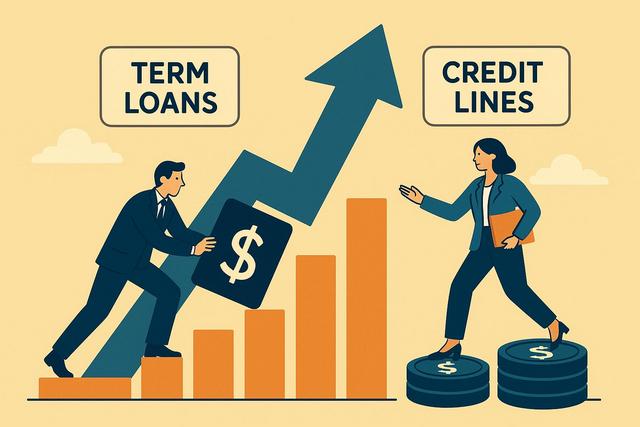
In today's dynamic financial landscape, businesses often face the critical decision of choosing between term loans and credit lines to meet their funding needs. Each financial tool has distinct characteristics, advantages, and drawbacks that can significantly impact a company's financial health and operational agility. This guide provides a comprehensive analysis of term loans versus credit lines, offering strategic insights and real-world examples to help businesses make informed decisions.
Term Loans Explained
Characteristics of Term Loans
Term loans are a lump sum of money borrowed from a financial institution, with a fixed repayment schedule over a specific period. They typically have fixed interest rates and are often used for long-term investments like equipment purchase or business expansion.
Real-World Examples of Term Loans
Consider a manufacturing company looking to invest in new machinery. By securing a $500,000 term loan at a 5% interest rate, the company can finance the machinery with predictable monthly payments. Over time, the new equipment boosts production and revenues, validating the investment.
Data Insights and Strategic Considerations
Statistics show that term loans are favored for their stability, with an average interest rate of 3-6% in the U.S. They are ideal for large capital expenditures but can be less flexible due to long-term commitment. Businesses must ensure consistent cash flow to meet repayment obligations.
Understanding Credit Lines
Characteristics of Credit Lines
A business line of credit provides access to a specified amount of funds, which can be drawn upon as needed, similar to a credit card. It offers flexibility, with interest charged only on the withdrawn amount and variable rates that might fluctuate.
Case Study: Credit Line Utilization
A retail store might utilize a $100,000 credit line to manage seasonal inventory demands. By borrowing $30,000 for holiday stock at a 7% interest rate, the store maintains cash flow flexibility, repaying the credit quickly once sales yield returns.
Analytical Perspective on Credit Lines
Data from financial experts reveal that credit lines offer flexibility with an average interest rate ranging from 4% to 10%, depending on creditworthiness. They are particularly useful for managing short-term deficiencies but require disciplined financial management to avoid excessive interest costs.
Term Loans vs Credit Lines: Comparative Analysis
Flexibility vs. Stability
| Criteria | Term Loans | Credit Lines |
|---|---|---|
| Structure | Fixed amount, fixed term | Revolving credit, flexible terms |
| Interest | Generally fixed | Typically variable |
| Use Case | Long-term investments | Short-term liquidity |
Strategic Financial Planning Considerations
Term loans are suited for business expansion while credit lines are optimal for day-to-day operations. Businesses should assess their capital need frequency and repayment propensity to choose the best option.
Key Financial Benefits and Risks
Evaluating the Benefits
- Predictability: Term loans offer financial certainty in repayments.
- Versatility: Credit lines provide access to capital when needed without upfront obligations.
Addressing the Potential Risks
- Advanced approvals and commitment are often extensive with term loans, while the fluctuating interest of credit lines can lead to unanticipated financial strain.
Implementation and Strategic Decision-Making
Steps for Implementation
- Financial Assessment: Evaluate current assets, liabilities, and cash flow.
- Objective Clarity: Define the business purpose for the funds clearly, aligning with financial goals.
Integration with Business Strategy
Incorporate external financial resources like credit lines into cash flow management strategies to optimize operational efficiency and ensure sustainable growth.
Conclusion
Term loans and credit lines both serve distinct yet overlapping roles in business financing. The choice between the two hinges on the business’s immediate capital needs, repayment capacity, and the long-term financial strategy. For businesses aiming for stable growth with specific improvement projects, term loans provide a structured route. Conversely, credit lines cater to those requiring operational flexibility and cash flow cushioning. By carefully assessing their financial landscape, businesses can select the financial instrument that ensures not only immediate monetary relief but also future financial health.
Key Takeaways and Implementation Steps
- Align the choice of financing tool with the business lifecycle stage.
- Conduct detailed financial analysis before commitment.
- Regularly review financial resources to adapt to changing business needs.
- Maintain good credit health to secure favorable terms and interest rates.

